Lung Cancer Screening (LDCT): 20 Pack-Year Eligibility & Lung-RADS Nodule Guide
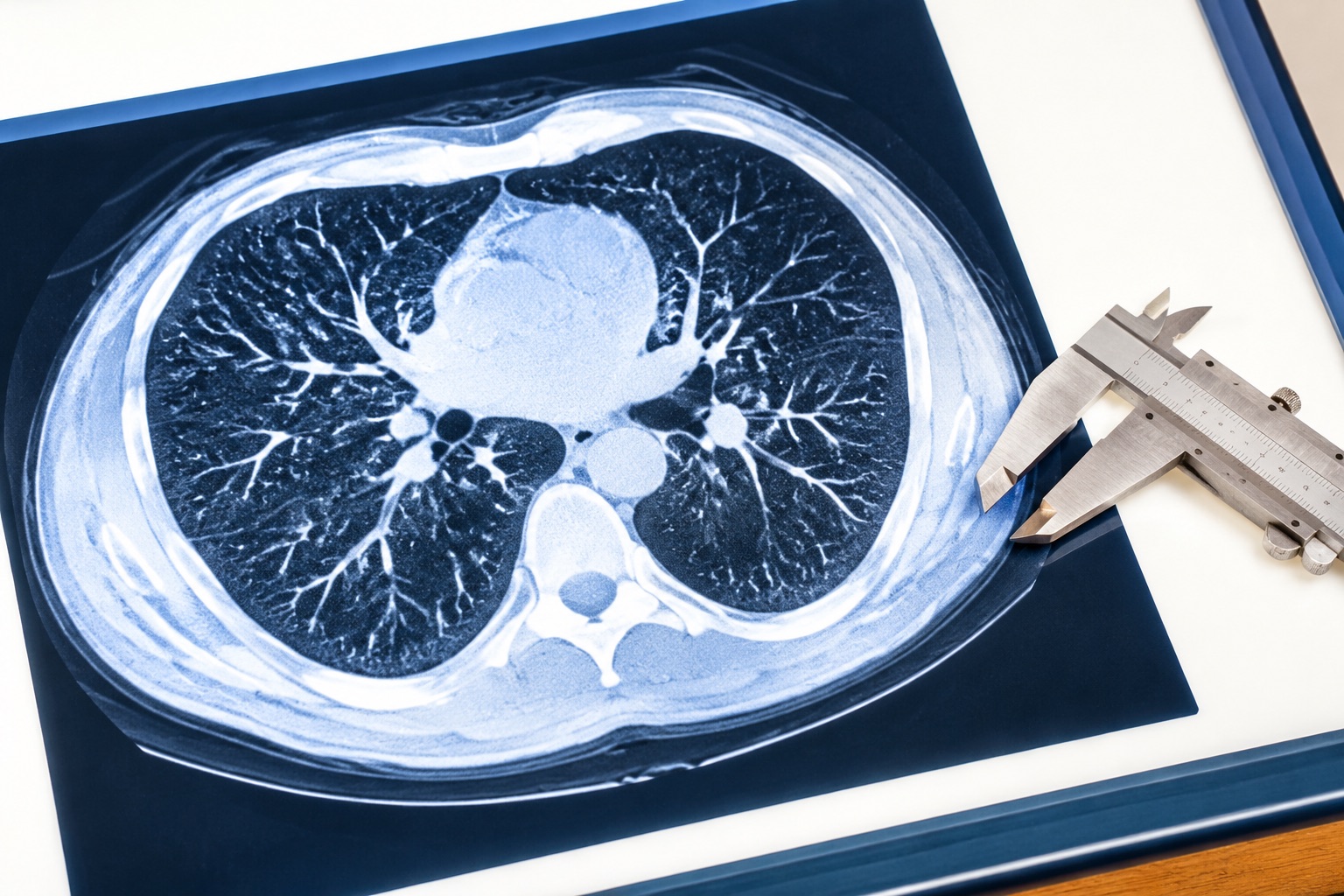
Chest X-rays and sputum cytology never reduced lung cancer mortality in randomized trials. By contrast, the National Lung Screening Trial (NLST, n = 53,454) and the European NELSON trial (n = 15,792) proved that annual low-dose helical CT (effective dose ~1.5 mSv, roughly one-fifth of a diagnostic chest CT) shifts detection from Stage IV to resectable Stage IA, saving ~3.2 lives per 1,000 high-risk adults screened over 3 annual rounds.
Annual low-dose computed tomography (LDCT) reduces lung cancer mortality by 20% to 24% in high-risk current and former smokers. Both the USPSTF and the American Cancer Society (ACS) recommend annual LDCT for adults aged 50 to 80 with at least a 20 pack-year smoking history; however, while the USPSTF stops screening 15 years after quitting, the 2023 ACS guideline eliminated the years-since-quitting cutoff entirely.
Verify Your USPSTF & ACS 2023 LDCT Eligibility
Formula: Pack-Years = (Cigarettes smoked per day ÷ 20) × Years smoked. Adjust values below to check federal ACA coverage vs. ACS 2023 clinical eligibility.
| Lung-RADS Category | Frequency in Screening | Typical Nodule Finding (Solid / Part-Solid) | Estimated Malignancy Risk | Recommended Clinical Management |
|---|---|---|---|---|
| Category 1 (Negative) | ~39% | No pulmonary nodules, or nodules with benign calcification (granuloma, hamartoma). | <1% | Continue routine annual LDCT screening in 12 months. |
| Category 2 (Benign Appearance) | ~45% | Solid nodule <6 mm at baseline (or new <4 mm); ground-glass nodule <30 mm. | <1% | Reassurance: Still classified as a negative screen; continue routine annual LDCT in 12 months. |
| Category 3 (Probably Benign) | ~9% | Solid nodule 6 to <8 mm at baseline (or new 4 to <6 mm); part-solid >=6 mm with solid core <6 mm. | 1% to 2% | 6-month follow-up low-dose CT to assess volumetric doubling time (98%+ prove benign or stable). |
| Category 4A (Suspicious) | ~4% | Solid nodule 8 to <15 mm at baseline (or growing <8 mm); part-solid with solid core 6 to <8 mm. | 5% to 15% | 3-month follow-up LDCT; PET/CT may be considered if solid component is >=8 mm. |
| Category 4B / 4X (Very Suspicious) | ~3% | Solid nodule >=15 mm or new/growing >=8 mm; part-solid with solid core >=8 mm or spiculated margins. | >15% | Diagnostic chest CT, PET/CT, and multidisciplinary tissue sampling or surgical evaluation. |
Frequently Asked Clinical Questions
Plain-language answers grounded in USPSTF, ACS, and 1,000-person cohort data.
Why did the American Cancer Society eliminate the 15-year quit-time limit in 2023?
Although lung cancer risk drops by roughly half within 10 to 15 years after smoking cessation, former heavy smokers (20+ pack-years) continue to accumulate age-related lung cancer risk that remains 3-fold to 5-fold higher than never-smokers even 20 to 25 years after quitting. CISNET modeling for the 2023 ACS update showed that removing the 15-year quit cap prevents 21% more lung cancer deaths with minimal change in false-positive biopsy rates.
Source: Multi-Society Lung Concordance
My LDCT report found a 4 mm lung nodule (Lung-RADS 2). Should I get a biopsy?
No. In the NLST and clinical Lung-RADS registries, small solid nodules under 6 mm (Lung-RADS Category 2) are found in nearly half of all screened adults - especially in regions with prior histoplasmosis or granulomatous exposure - and carry a malignancy probability under 1%. Biopsying a 4 mm nodule causes far more harm (pneumothorax) than benefit; standard management is simply repeating your routine annual LDCT in 12 months.
Source: NCI NLST Pulmonary Nodule Data